Data Science in the BIO and BMARSYS Bachelor Programmes
The Data Science Bachelor programme aims to standardise and optimise education in contemporary handling of scientific data for future biologists. The programme and its modules are designed for students across the entire Department of Biology from the first semester onwards.
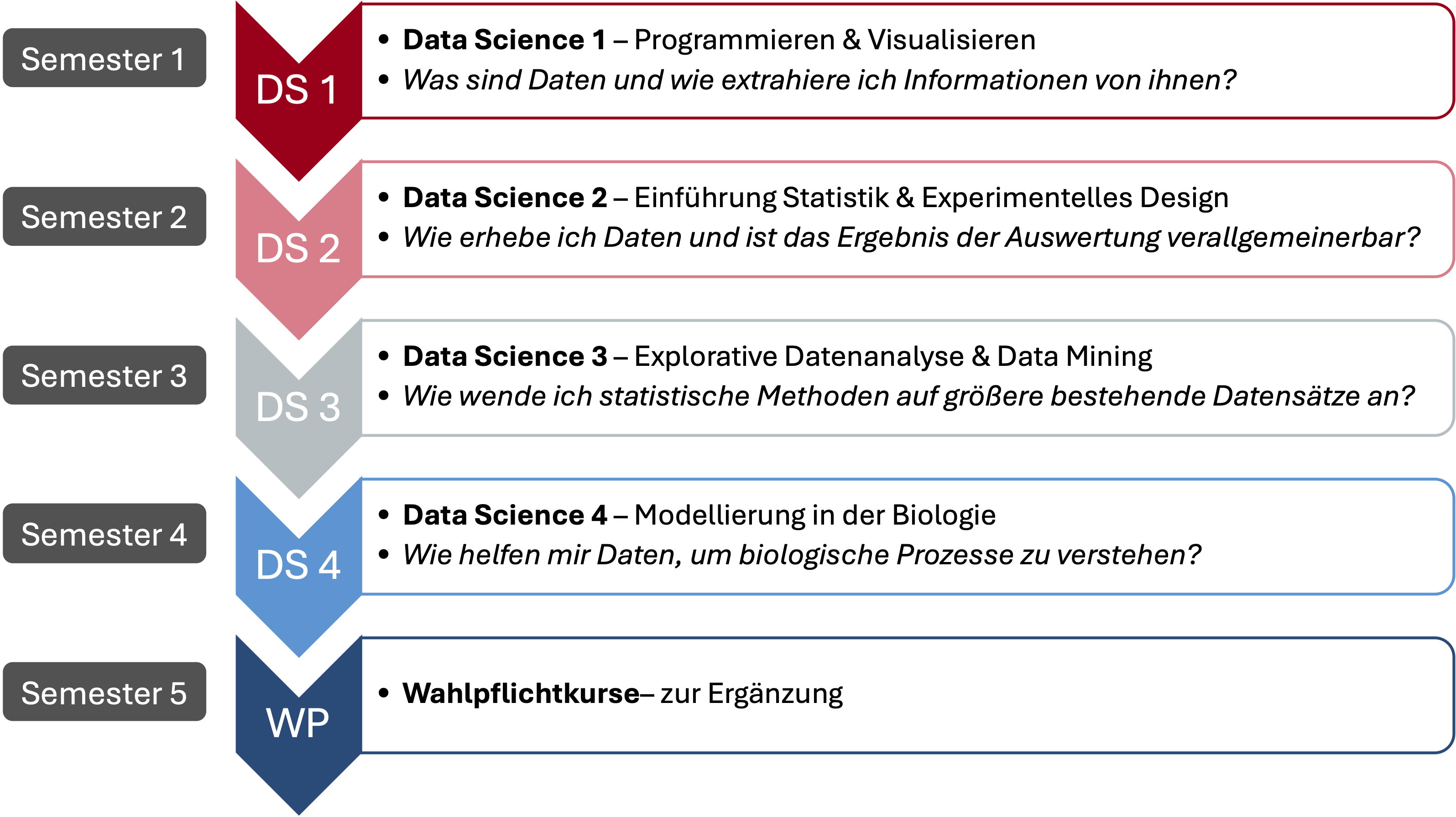
The modules build upon each other progressively. This ensures that acquired knowledge is continuously applied, practised, and deepened. The goal is to teach students a routine approach to data handling, visualisation, and analysis. This should also make the analysis of their first own data during the Bachelor thesis run more smoothly.
Teaching Format (DS1–DS3)
The modules Data Science 1–3 follow a common teaching format:
Lecture (90 or 45 min weekly)
- Web-based HTML lecture slides with embedded quizzes during the lecture and a concluding knowledge quiz per session
- Lecture recording (available via Moodle)
- Helpful: phone, tablet, or computer to follow along
Small-Group Exercises (90 or 45 min weekly) — Attendance required!
- Exercises in the programming language R (with RStudio)
- Online quizzes for self-assessment (Moodle)
- Completion of a case study with final review
- Required: computer or tablet
Examination: Written exam (graded, 100%) + successful completion of exercises (case study) — both can be completed independently of each other.
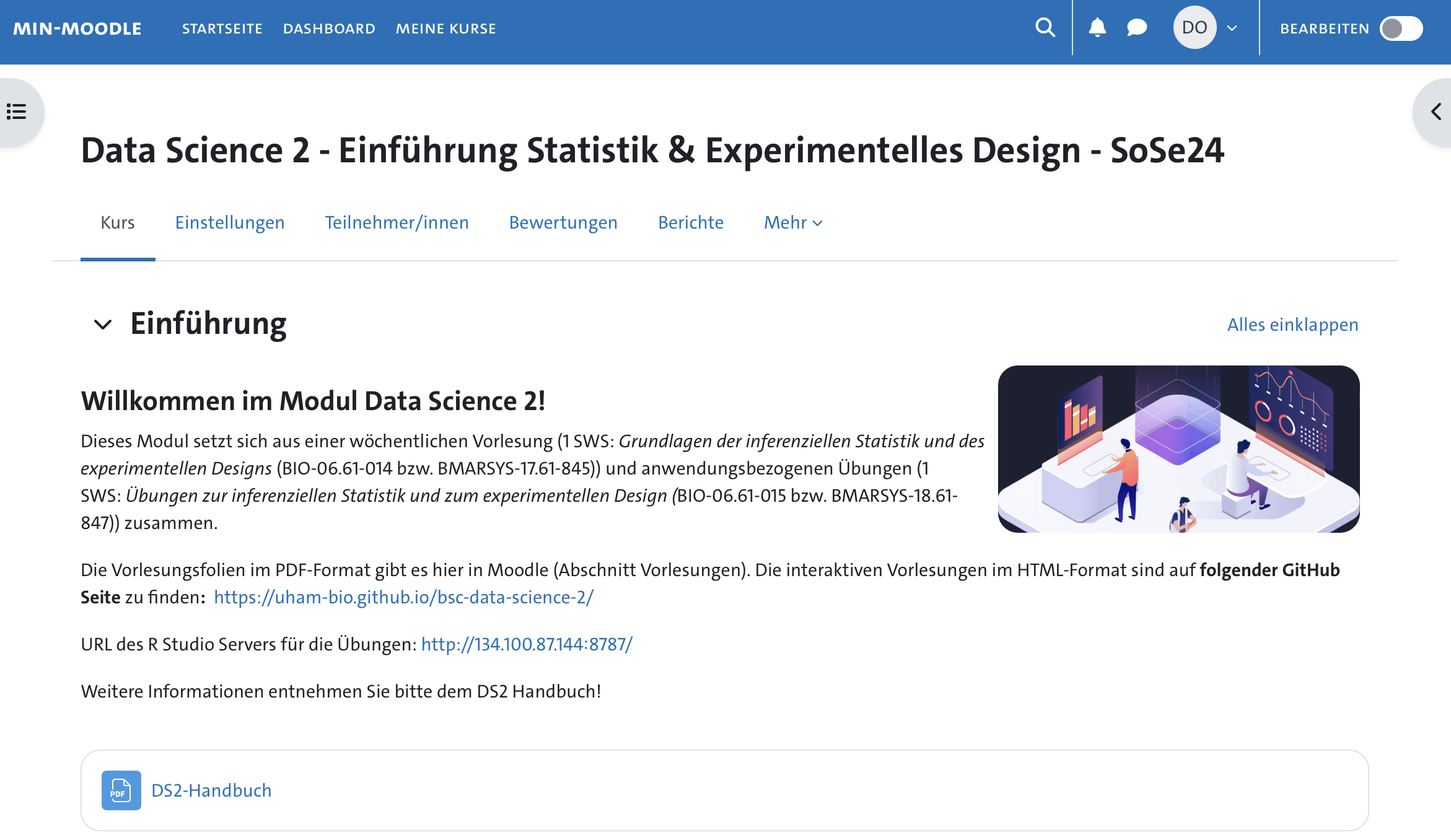
Moodle serves as the central platform for exercise materials, quizzes, lecture recordings, and communication (access with B-Kennung):
Link: UHH MIN Login
Modules at a Glance

Data Science 1 — Programming & Visualisation
Compulsory module (BSc BIO / BMARSYS) · Winter semester · 4 SWS
This is the first module of the Data Science programme. It provides an introduction to the various data science components. Following an introduction to the spreadsheet application LibreOffice Calc, the module covers the programming language R and the development environment RStudio. Methods and tools for data entry and organisation, import, manipulation, visualisation, and description of data are taught.

Data Science 2 — Statistics & Experimental Design
Compulsory module (BSc BIO / BMARSYS) · Summer semester · 2 SWS
Building on Data Science 1, this module provides an introduction to the world of stochastics and inferential statistics. The fundamentals of probability theory, distributions, and statistical tests are covered, along with experimental design and study planning.

Data Science 3 — Exploratory Data Analysis & Data Mining
Compulsory module (BSc BIO / BMARSYS) · Winter semester · 2 SWS
The third module bridges the gap from analysing one’s own experiments to working with large secondary datasets. The methodological spectrum ranges from multi-factorial ANOVAs, mixed models, and resampling to multivariate statistics and an introduction to machine learning.

Data Science 4 — Mathematical Modelling
Compulsory module (BSc BIO) · Winter semester · 2 SWS
This module teaches the fundamentals of quantitatively representing biological processes through mathematical functions. Note: For BMARSYS students, DS4 has a different content focus.
This module is currently not provided through this website.